
Cybersecurity Assessments: When to Get One and What You Gain
Ask yourself one question. When did an expert last test whether your security actually works?
If you’re not sure, you’re in good company. Plenty of growing businesses buy firewalls, antivirus, and backups, then assume they’re covered. Those tools are a start. They don’t prove anything.
An assessment does. It shows what’s protected, what isn’t, and what to fix first. At Tech Group, our partner Cyber74 handles our advanced cybersecurity testing and coverage. This article covers three assessments most businesses should know about.
What a cybersecurity assessment is
Think of it as a physical for your business. A specialist checks your systems, finds weak spots, and hands you a plan. You don’t wait for symptoms.
Cyber74’s assessments are led by highly skilled cybersecurity experts. They use people, not just tools. And they follow industry best practices based on the NIST and CIS frameworks.
The human part matters. A scanner finds known problems. An experienced professional asks how those problems connect and what an attacker would do with them.
Three assessments worth knowing
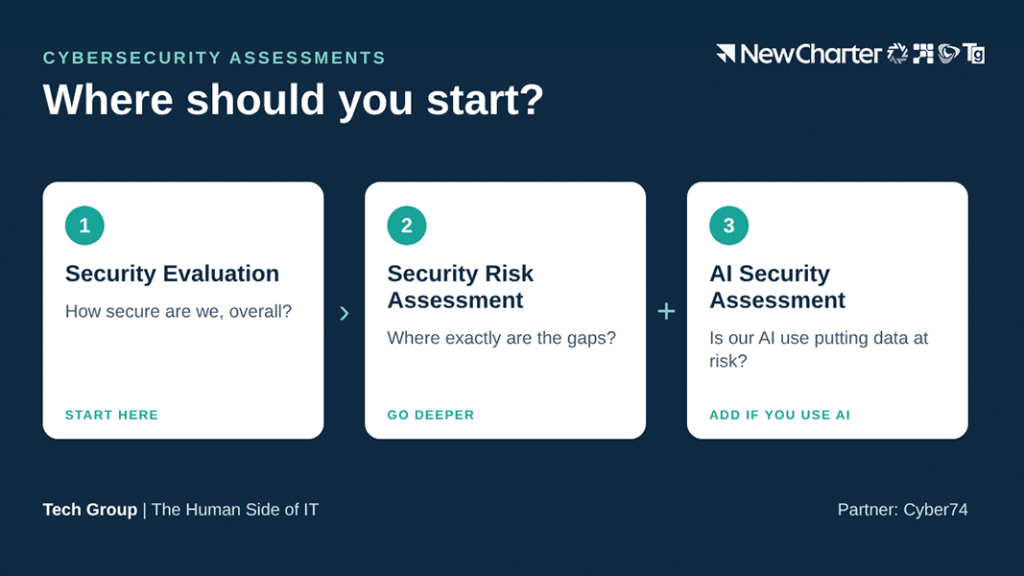
- Security Risk Assessment (SRA). A full audit of your systems and safeguards. Cyber74 notes that NIST, CMMC, NY-DFS, PCI DSS, and HIPAA call for these on a regular basis.
- Security Evaluation (SE). A review of your overall security posture. It gives you the big picture of where you stand.
- AI Security Assessment. A look at how your business uses AI tools, what data they touch, and who controls access.
Which one first? Generally, start with an SRA if a regulation or customer requires proof. Start with an SE if you want a broad read on where you stand. Add the AI assessment if your team already uses AI tools. Most businesses end up needing more than one.
Your AI tools need a security check too
Some of your people probably use AI tools already, approved or not. Each prompt can carry client data, contracts, or financials outside your control.
IBM’s 2025 breach report puts numbers on the gap. Of organizations that reported a breach of an AI model or application, 97% had no AI access controls. One in five reported a breach tied to unsanctioned “shadow AI.”
Those high-shadow-AI breaches cost an average of $670,000 more. And 63% of breached organizations either had no AI governance policy or were still writing one.
An AI security assessment looks at the basics:
- Which AI tools your team uses, including the ones nobody approved.
- What company data goes into them, and where it ends up.
- Who has access, and how you control it.
- Whether Microsoft 365 permissions let an AI assistant surface files it shouldn’t.
- Whether you have a written AI policy that people actually follow.
NIST gives you a voluntary yardstick. Its AI Risk Management Framework came out in January 2023. A Generative AI Profile followed in July 2024.
When you should get one
Don’t wait for a contract, an auditor, or an incident to force the issue. Here are the moments that call for an assessment.
- After changes to your IT environment. A cloud move, a new office, or new business software all change your risk.
- After personnel changes. A departing IT lead or a new executive team can leave gaps no one notices.
- When new regulations apply to you. Your industry rules may have changed since your last review.
- After a security incident. Malware, ransomware, or a successful phishing email all qualify.
- When your team starts using AI tools. Adoption often runs ahead of policy.
- If you’ve never had one. Start with a baseline. You can’t improve what you haven’t measured.
We suggest treating assessments as a regular habit, not a one-time project. Your business changes. Your risk changes with it.
What cyber insurance often looks for
Every carrier is different, so ask your broker for specifics. But applications tend to ask about the same basics.
- Multifactor authentication on email, remote access, and administrator accounts.
- Endpoint detection and response, not just basic antivirus.
- Backups that are protected from attackers and tested by restoring them.
- A regular patching routine, with records.
- Security awareness training for employees.
- A written incident response plan, sometimes tested with a tabletop exercise.
A Security Risk Assessment or Security Evaluation tells you honestly where you stand on each item. That matters, because the application is a legal statement. In 2022, Travelers asked a federal court to rescind a policy. It alleged the policyholder’s MFA protected only its firewall.
Better to find the gap yourself than during a claim. Ask your broker whether your carrier wants a recent assessment on file.
What the return looks like
We can’t quote a universal ROI percentage. We found no reliable published figure for assessments. But you can build your own case from four pieces.
- Avoided loss. IBM’s 2025 report put the U.S. average breach at $10.22 million, up 9% and a record. That average covers organizations of all sizes, so your cost could differ.
- Coverage you can collect. An honest, documented picture of your controls reduces surprises at application and claim time.
- Smarter spending. A ranked fix list keeps you from buying tools you don’t need.
- Compliance covered. If your rules call for regular risk assessments, you meet them and keep the record.
Here is a quick test. Estimate what one day offline costs your business. Multiply by the days a serious incident could take to recover. Compare that number to the assessment fee.
How an assessment benefits your business
- You find problems before attackers do.
- You confirm that your safeguards actually work.
- You get an unbiased, outside view of your security posture.
- You get a prioritized roadmap, so you spend budget on the fixes that matter most.
- You get a clear record of where you stand, which helps in every leadership conversation about risk.
Which assessment is right for you?
Not sure where to start? That’s normal. Each assessment answers a different question. Some measure your risk. Some give the big picture. One checks your AI use.
Reach out to Tech Group. We’ll help you pick the right assessment for your business and goals.
Tech Group | The Human Side of IT
sales@tgvt.net | 802-862-1197 | www.TGVT.net

